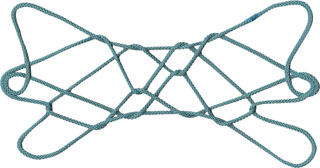
| Ten Men | String Figures — C. F. Jayne 1906 p.150 | [15] |
| Tal geai trímethmúth ra gerger | Die Faden- und Abnehmspiele auf Palau — P. Raymund 1911 p.47 | [18] |
| Multiple Diamonds | Mathematical Recreations and Essays — W. W. R. Ball 1911 p.363 | [19] |
| Die zehn Männer | Nauru — P. Hambruch 1914 p.362 | [25] |
| Nameless | String Figures from New Caledonia and the Loyalty Islands — R. H. Compton 1919 p.218 | [31] |
| Number (Na'ba) | Papuan Cat's Cradles — D. Jenness 1920 p.306 | [32] |
| Koukape (a membrane between the intestines) | String Figures from the Marquesas and Society Islands — W. C. Handy 1925 p.29 | [41] |
| Firi Rau Anani (plait of orange leaves) | String Figures from the Marquesas and Society Islands — W. C. Handy 1925 p.67 | [41] |
| Imbi (mat) | String Figures from Fiji and Western Polynesia — J. Hornell 1927 p.45 | [43] |
| Loukabe (kabe leaf) | String Figures from Fiji and Western Polynesia — J. Hornell 1927 p.67 | [43] |
| Takapau | Māori String Figures — J. C. Andersen 1927 p.25 | [45] |
| Beira | String Figures from British New Guinea — W. E. Rosser, J. Hornell 1932 p.47 | [58] |
| Crocodile | Aboriginal Australian String Figures — D. S. Davidson 1941 p.844 | [69] |
| Ba ni Mai (Leaves of the Breadfruit) | String-Figures from the Gilbert Islands — H. C. & H. E. Maude 1958 p.102 | [77] |
| Parrot (Dummala) | The String Figures of Yirrkalla — F. D. McCarthy 1960 p.464 | [78] |
| sesos (Früchte einer Lianen-Art) | Fadenspiele vom Unteren Watut, und Banir River (Ost-Neuguinea) — H. Fischer 1960 p.182 | [79] |
| Raukape I | Tikopia String Figures — R. Firth, H. C. Maude 1970 p.34 | [91] |
| The Ten Men | The String Figures of Nauru Island — H. C. Maude 1971 p.5 | [92] |
| 10人の男 | あやとり — 野口広 1973 p.143 | [96] |
| Nuvo (net) | Solomon Islands String Figures — H. C. Maude 1978 p.29 | [105] |
| Hata'e Erere (eagle hovering) | Solomon Islands String Figures — H. C. Maude 1978 p.30 | [105] |
| Mageogeo | String Figures of the Tuamotus — K. P. Emory, H. C. Maude 1979 p.7 | [106] |
| Mother | String Figures of Papua New Guinea — P. D. Noble 1979 p.150 | [107] |
| Ten Men | Cat's Cradles and Other String Figures — J. Elffers, M. Schuyt 1980 p.200 | [111] |
| Salibu (Der Spiegel) | Ninikula fadenspiele auf den Trobriand-Inseln, Papua Neuguinea — B. & G. Senft 1986 p.164 | [123] |
| Na wiwi (The crossings) | String Figures from Pukapuka — P. Beaglehole, H. C. Maude 1989 p.14 | [127] |
| The ten men | The String Figures of Nauru Island — H. C. Maude, ISFA 2001 p.27 | [135] |
| HIHI RAU APE / HIHI RUAPE | 7b - Notas Sobre el Kaikai — L. Baeza 2017 p.65 | [145] |
| Mata Vulu (Eight Squares) | String Figures from Tonga — H. C. Maude (BSFA 13) 1986 p.14 | [151-13] |
| Gomakiam (a kind of taro) | String Figures from Torres Strait : Laade 1965 — H. C. Maude (BSFA 14) 1987 p.16 | [151-14] |
| Raupaka tatai (taro-leaf mat) | String Figures of the Austral Islands : Stokes 1920 — M. Sherman (BISFA 1) 1994 p.98 | [154-1] |
| Mataki Beti | The String Figures of Tuvalu — H. C. & H. E. Maude (BISFA 3) 1996 p.137 | [154-3] |
| Tal geai trímethmúth ra gerger | The String Games and Cat's Cradles of Palau : Raymund 1911 — A. Reichert (BISFA 13) 2006 p.83 | [154-13] |
| Gomakiam (mashing Gomakiam, a kind of Taro) | Wame: String Figure Chants and Stories from Saibai Island, Torres Strait : Laade 1965 — S. Claassen (BISFA 21) 2014 p.162 | [154-21] |
| Nimeluǩ (kava) | Some String Figures from Vanuatu : Deacon 1926 — M. Sherman (BISFA 22) 2015 p.201 | [154-22] |